
A tow truck pulling up on a shoulder at 2 a.m. is rarely the first sign anything was wrong. Usually it’s the fourth or fifth. Somewhere back in the timeline there was a dash light that got dismissed, a tire that needed air more often than it used to, or a brake pedal that felt a little softer than it did last month. Roadside breakdowns almost never come out of nowhere; they come out of a pattern that a driver or a fleet decided not to look at too closely.
Here’s the part most “top causes of breakdowns” articles get muddled: they quietly merge two different datasets as if they answer the same question. One is the Technology and Maintenance Council’s roadside call data, which says tires cause roughly 53.5 percent of roadside breakdown events – by far the single biggest slice. The other is the Commercial Vehicle Safety Alliance’s 2025 International Roadcheck results, which says brake systems, not tires, are what actually gets a truck placed out of service most often during a planned inspection. Those aren’t contradictory. They’re measuring two different moments: what strands you on I‑40, versus what gets you written up (or shut down) at a scale house. I think that distinction matters more than either number on its own, because it tells you which signs deserve a five-minute look today and which ones deserve an appointment this week.
What the 2025 Roadcheck actually found
Over three days in May 2025, inspectors across the U.S., Canada, and Mexico ran 56,178 commercial vehicle, driver, and cargo inspections as part of CVSA’s International Roadcheck. Just over 18 percent of the vehicles inspected – 10,148 trucks – were pulled out of service until violations were fixed. Brake problems were the single biggest reason, by a wide margin.
| Rank | Vehicle Violation Category | % of All Vehicle OOS Violations |
|---|---|---|
| 1 | Brake Systems | 24.4% |
| 2 | Tires | 21.4% |
| 3 | 20% Defective Brakes | 16.7% |
| 4 | Lights | 12.8% |
| 5 | Cargo Securement | 11.4% |
Source: CVSA, 2025 International Roadcheck (56,178 inspections, May 13–15, 2025). Combined, “Brake Systems” and “20% Defective Brakes” account for 41.1% of every out-of-service vehicle violation written that week.
Notice what’s missing from the top of that list: the tire figure everyone quotes is real, but it’s a rate of roadside events, not a rate of inspection failures. A tire is more likely to be the thing that actually strands you. Brakes are more likely to be the thing an inspector finds wrong even when the truck hasn’t broken down yet – which is arguably the more useful number, because it’s catching problems before they turn into a shoulder stop. My take is that brake-related signs deserve more attention than their frequency in breakdown-call data suggests, precisely because the consequence of ignoring them is disproportionate to how often they show up.
1. Tread wear that isn’t random, and pressure you keep having to top off
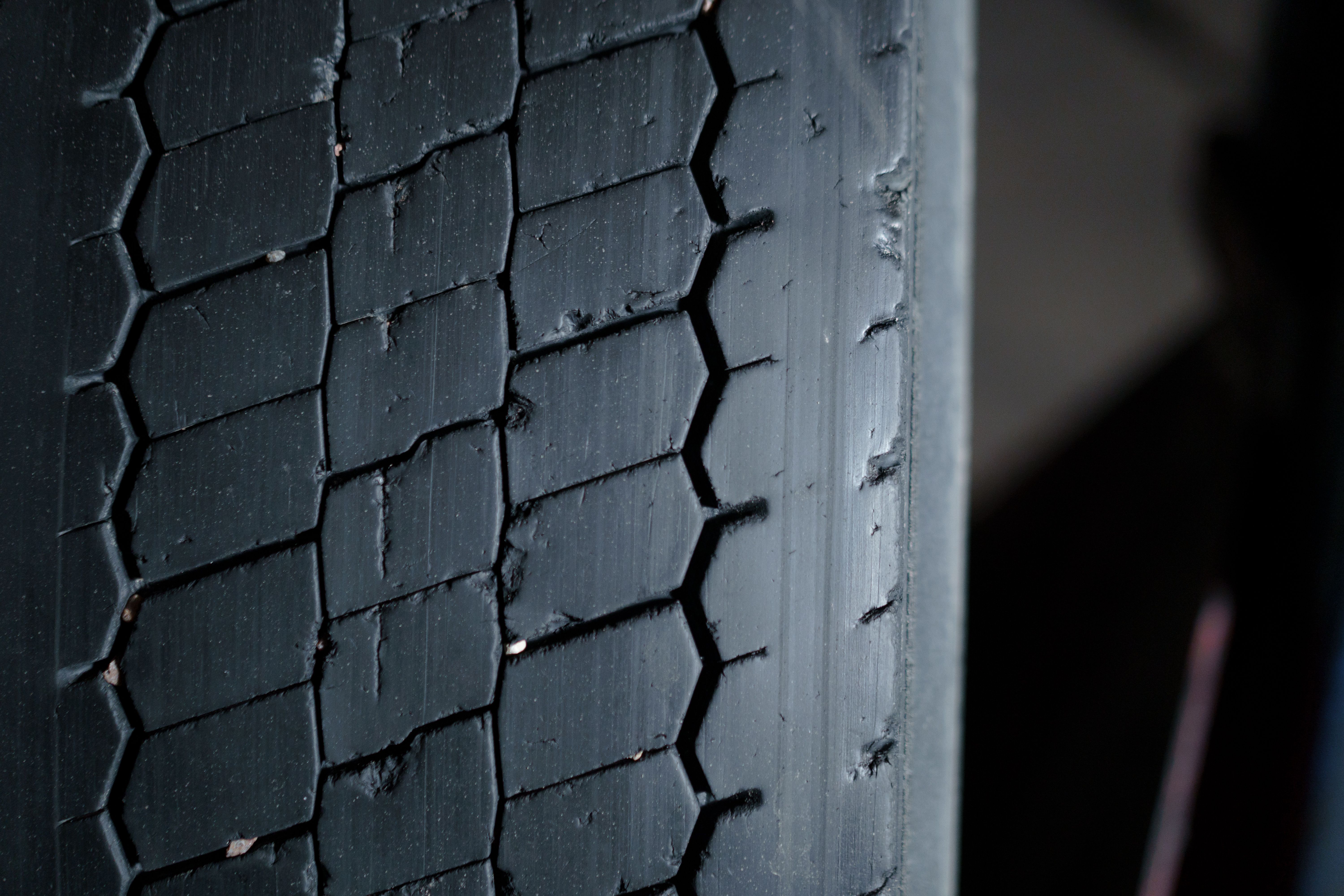
Uneven wear across a tread – cupping, feathering, wear concentrated on one shoulder – is the tire telling you something upstream is off: misalignment, an imbalanced load, a skipped rotation. Random-looking wear is rarely random. Underinflation is the more dangerous variant, because it builds heat inside the tire wall gradually and invisibly, and heat is the primary trigger behind a blowout. The Federal Motor Carrier Safety Administration estimates tire blowouts cause roughly 8,000 trucking accidents a year in the U.S.
The inspection thresholds are specific for a reason: 4/32 inch of tread in every major groove on a steer axle, 2/32 inch on drive and trailer axles, and any tire below 50 percent of its rated sidewall pressure is an out-of-service condition on the spot. I’d argue checking pressure with an actual gauge, not the thump test, is the single highest-leverage five minutes in a pre-trip – nothing else on this list is this cheap to catch early and this expensive to ignore.
2. Dashboard lights that keep coming back

A modern Class 8 truck carries well over 100 electronic control units talking to each other over multiple CAN bus networks. That’s useful right up until a fault code shows up somewhere that isn’t actually where the problem started. A DPF or DEF warning, for instance, can put the truck into reduced-power “derate” mode, but the root cause is sometimes upstream of the aftertreatment system entirely.
There’s a documented case worth knowing: a driver reportedly spent weeks and thousands of dollars chasing recurring DPF fault codes, only to eventually trace them to an oil leak further up in the engine that had been loading the filter with contaminated soot the whole time – a diagnosis chain detailed via FreightWaves and Diesel Laptops’ Tyler Robertson. Clearing the code and sending the truck back out doesn’t fix that; it just resets the clock until the filter fails again. A light that clears and comes back within days or weeks is not a fluke. It’s a system telling you the same story twice.
3. A brake pedal that’s starting to lie to you
Softness, a pull to one side, grinding, or a pedal that needs more travel than it used to are not cosmetic complaints. Brake-related problems were coded in almost 30 percent of large trucks involved in crashes examined by FMCSA’s Large Truck Crash Causation Study, compared with about 5 percent of the passenger vehicles in the same crashes. That study also found something genuinely surprising: vehicle problems were the critical reason in only about 10 percent of the truck crashes examined overall – most large truck crashes trace back to driver decisions, not mechanical failure. But when a truck’s own condition was the reason, the causes concentrated almost entirely in three places: braking capacity, tire or wheel failure, and cargo shift. Mechanical failure isn’t the main story in trucking crashes. When it is the story, it’s very often this one.
Air brake systems add their own failure mode: pushrod travel beyond allowable limits is the single most cited brake out-of-service violation nationally, and an automatic slack adjuster that someone has been manually adjusting is itself a sign the underlying mechanism has already failed. A soft or uneven pedal isn’t something to monitor for a week. It’s something to get looked at before the next load.
4. Temperature creep and a smell that doesn’t belong under the hood
A gauge that’s running a few degrees warmer than it used to, a sweet smell drifting into the cab, or coolant you find yourself topping off more than you’d like are early signs of a cooling system on its way to a much worse day. Pinhole leaks in a hose or a weeping water pump seal drain coolant slowly enough that nobody notices until the temperature needle starts climbing on its own. A stuck-closed thermostat stops coolant from circulating at all; a stuck-open one keeps the engine from ever reaching proper operating temperature.
The cost curve here is one of the steepest on this list: a $200 hose replaced early stays a $200 hose. Ignored long enough, the same failure mode becomes a blown head gasket, a cracked cylinder head, or a full engine rebuild running well past $15,000. Nothing on a Class 8 truck punishes procrastination quite as efficiently as coolant.
5. Slow cranks and dim lights before a dead battery
Diesel engines need substantially more starting power than gasoline engines, which is exactly why a weakening battery announces itself before it quits outright: labored cranking, headlights that dim under load, clicking instead of turning over. A commercial truck battery typically lasts three to five years under normal conditions, less in extreme heat or cold, and that decline in cold-cranking amps happens well before the battery dies for good.
Electrical faults deserve more respect than their parts cost suggests. A battery, an alternator, and a starter are all individually cheap compared with a transmission or a DPF – but a grounding fault or a corroded connection can throw fault codes across several unrelated systems at once, which is how a $150 part turns into a $1,200 repair bill from parts swapped in the wrong order. As one fleet electrical specialist put it in commentary cited by Millennials Maintenance, most unplanned downtime traces back to electrical faults rather than engine failure, and diagnosing the fault often takes longer than fixing it once found.
6. Hissing air and a brake lag you’ve started to expect
If you’ve caught yourself listening for a hiss during your walk-around, or noticing the air gauge builds a little slower than it used to, that’s not background noise to tune out. Air system leaks compromise service brakes, parking brakes, and – on newer trucks – the air controls for automated manual transmissions. A slow leak is often masked because the compressor just cycles more frequently to hold pressure, right up until the leak outgrows the compressor’s ability to keep up, usually at the worst possible moment.
The math on this one is unambiguous: proactive service on the compressor, air dryer, tanks, and lines runs roughly $150 to $450. Waiting for the failure runs $1,000 to $4,000, on top of the downtime and the safety risk of being stranded with no air at all. A saturated air dryer cartridge going into winter is a small, cheap, boring part to replace – and a frozen brake line on the shoulder in January is not boring at all.
7. Hard starts, rough idle, and smoke that changes color
Modern common-rail diesel fuel systems run at pressures exceeding 30,000 psi, which means even microscopic contamination – water, debris, degraded fuel – causes outsized problems. Extended cranking, a rough idle, or a loss of power under load are usually the fuel system’s first complaints, well before it fails outright. The color of the smoke is diagnostic on its own: black points to a fuel delivery issue, blue means the engine is burning oil, and white can mean either a coolant leak or a DEF system fault, depending on what else is happening.
Most manufacturers recommend replacing diesel fuel filters every 15,000 to 25,000 miles, shorter in dusty or hot-climate operations, because filters are the first line of defense against the contamination that eventually reaches – and damages – the injectors. A water-in-fuel warning light is not a light to reset and forget; it’s the system telling you the filter already caught something it shouldn’t have had to.
What to do before one sign becomes a breakdown
None of these seven signs, on their own, guarantees a breakdown is imminent. Two or more showing up together, though, is a pattern worth acting on immediately rather than at the next scheduled service. A soft pedal and a slow air buildup together are a different conversation than either one alone.
If the truck does go down on the shoulder despite the warning, the first job isn’t diagnosis – it’s getting off the traveled lane and making the stop visible. Federal rule 49 CFR §392.22 requires warning devices to be placed within 10 minutes of stopping in most roadside situations, which is a tighter window than it sounds like once hazards are on and the parking brake is set. Only after the scene is safe does it make sense to start working the phone: dispatch or safety first for authorization and shop choice, then whoever is actually going to fix the truck. That’s usually the point where knowing how to find truck repair services near you before you need them saves more time than anything else in the process – looking that up for the first time from the shoulder, with a load on the clock, is the wrong moment to start.
The uncomfortable truth is that almost every one of these seven signs was visible days or weeks before the tow truck showed up. That’s not a moral failing on the driver’s part; it’s how mechanical systems on a truck actually degrade – gradually, then suddenly. The pre-trip walk-around exists specifically to catch the gradual part while it’s still cheap.
How this article was put together
This piece drew on the Federal Motor Carrier Safety Administration’s Large Truck Crash Causation Study and safety data pages, the Commercial Vehicle Safety Alliance’s official 2025 International Roadcheck results, and industry maintenance-cost reporting from Millennials Maintenance, FleetRabbit, and Mango Automotive, all reviewed in August 2026. Repair cost ranges are reported as published by those sources rather than independently priced, and may vary by region, truck age, and shop. The TMC roadside-frequency figure and the CVSA out-of-service figures measure different things, as noted above, and should not be read as competing claims about the same statistic. Brake violation thresholds and inspection criteria are current as of the 2025 Roadcheck cycle and are worth rechecking against CVSA’s site if reading this more than a year or so out.